
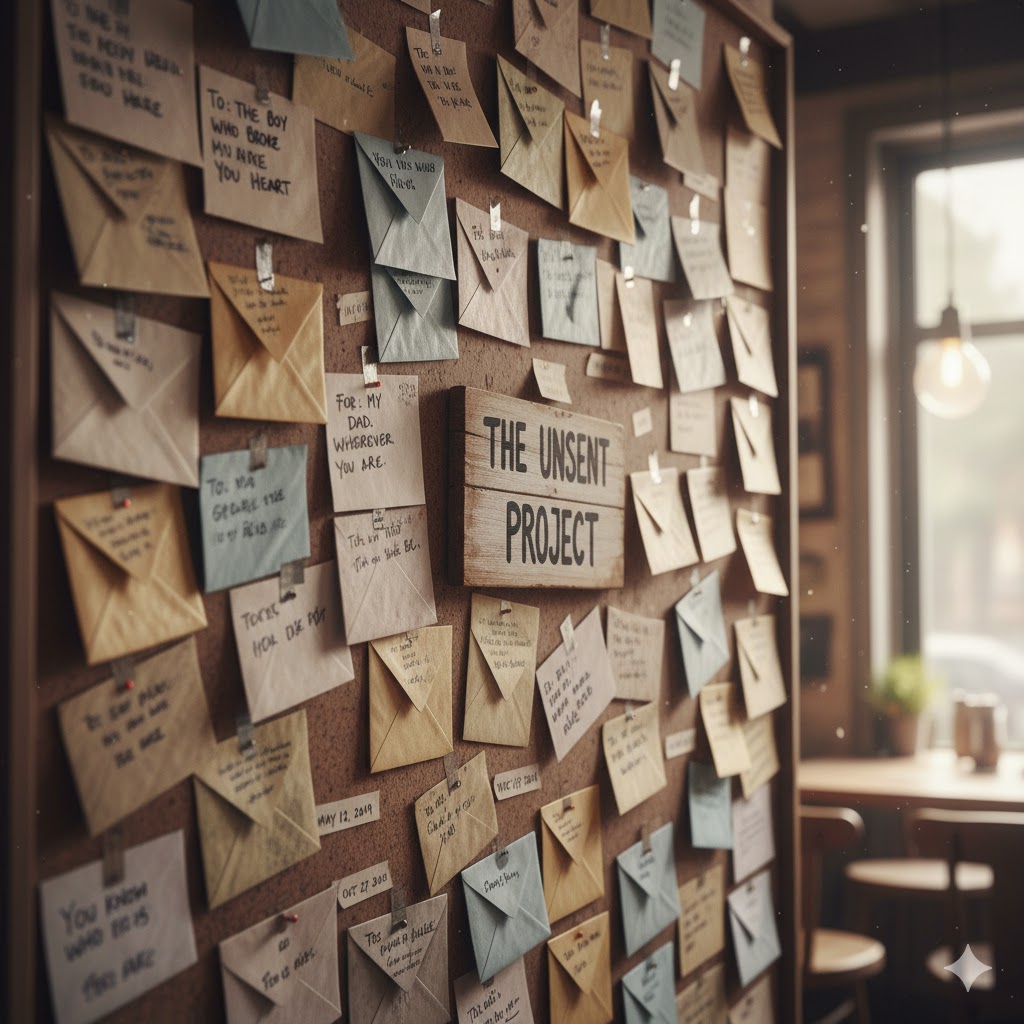
In a world dominated by instant communication, it’s easy to assume that everyone has found a way to express their emotions. But what about the words that never leave our lips, the messages we type and delete, or the letters we never send? These unspoken emotions form the heart of The Unsent Project — a globally recognized emotional art initiative that captures the complexity of human communication in the digital age.
What Is The Unsent Project?
The Unsent Project is a collaborative art project created by Rora Blue in 2015. Its central idea is simple yet profoundly moving: people from all over the world are invited to submit messages they have written but never sent — notes meant for someone they once loved, lost, or can no longer reach. Each submission includes a text message and a color the sender associates with that person or emotion.
Over time, this collection has grown into one of the largest online archives of unsent messages — an intimate museum of untold stories. Each message, just a few words long, reveals the universal human experiences of love, regret, heartbreak, forgiveness, and nostalgia.
How It Began
The Unsent Project began as a personal experiment. Rora Blue wanted to understand the relationship between color and emotion, and how people visually associate feelings with certain hues. She asked friends and online followers to send anonymous text messages they never sent to their first loves, along with the color they connected with that person.
The response was overwhelming. Within weeks, hundreds of submissions poured in. What started as a small creative project quickly evolved into a powerful digital confession booth. People were ready — even desperate — to share what they could never say aloud.
Today, The Unsent Project has collected over a million submissions from people around the world.
How It Works
Submitting a message to The Unsent Project is simple. Participants visit the official website (theunsentproject.com) and fill out a short form:
- Write your unsent message — a note, thought, or confession meant for someone specific.
- Choose a color that represents that person or the emotion tied to them.
- Optionally, include the recipient’s first name.
Once submitted, the message appears anonymously within the project’s massive archive. Visitors can browse messages by color or by the recipient’s name, seeing the incredible spectrum of emotion shared by strangers around the globe.
For example, a few messages you might find:
“I wish you had fought for me.”
“Every blue sky reminds me of you.”
“I’m happy you moved on, even if it still hurts.”
These fragments are raw, brief, and devastatingly honest — a digital echo of emotions too fragile to be spoken aloud.
The Meaning of Color in The Unsent Project
One of the most striking features of The Unsent Project is its use of color psychology. Each message is tagged with a color that the sender associates with the person or feeling connected to their message.
For some, blue symbolizes calmness, sadness, or nostalgia. For others, red represents passion, anger, or deep love. Purple often signifies mystery or spiritual connection, while yellow may evoke joy or warmth.
This visual spectrum transforms the website into a massive emotional mosaic — each shade representing a unique human experience. Browsing through the submissions becomes a deeply emotional experience: a scroll through heartbreak, longing, and the tender beauty of unsent words.
Why The Unsent Project Resonates So Deeply
There’s a reason millions of people have connected with The Unsent Project. It speaks to something universal — the emotions we repress, the things we never say, and the people who stay in our memories long after they’ve left our lives.
1. It offers emotional release
Writing an unsent message is cathartic. It allows people to process emotions — grief, regret, love — without the fear of judgment or consequence. Many participants describe it as a form of emotional therapy, helping them let go or find closure.
2. It provides a sense of connection
When you read the messages of others, you realize that pain, love, and longing are shared human experiences. There’s comfort in anonymity — strangers from around the world expressing the same feelings you thought were uniquely yours.
3. It challenges the culture of oversharing
In a time when social media promotes constant expression and perfection, The Unsent Project celebrates silence and restraint. It honors the words that stay unsaid — the quiet truth that sometimes, not saying something is the most powerful form of communication.
The Psychological Perspective
From a psychological viewpoint, The Unsent Project taps into the concept of expressive writing therapy, a practice that encourages writing about emotions as a means of healing. Research suggests that expressing emotions through writing can:
- Reduce stress and anxiety
- Improve emotional regulation
- Enhance self-understanding
- Help individuals process trauma or loss
By providing a safe, anonymous outlet for these emotions, The Unsent Project acts as a digital diary for collective healing — a space where vulnerability is not only accepted but celebrated.
Cultural and Artistic Impact
The Unsent Project has transcended its digital form to influence art, literature, and mental health discussions globally. Its creator, Rora Blue, has exhibited the project in art galleries and installations, where walls are covered with thousands of printed messages — each representing a life, a story, a memory frozen in time.
The project has also inspired other creative works — from poetry and short films to academic papers analyzing digital intimacy, emotional expression, and the psychology of anonymity online.
It demonstrates that art doesn’t always need to be created with intention — sometimes, it emerges from the collective emotions of ordinary people.
Criticism and Controversy
Despite its widespread praise, The Unsent Project has faced some criticism. Detractors argue that browsing through the messages can be emotionally triggering, particularly for those dealing with heartbreak or depression. Others question whether reading others’ intimate thoughts might feel voyeuristic.
However, Rora Blue has always emphasized that the project’s goal is healing through shared emotion, not sensationalism. The anonymity and voluntary participation ensure that each message remains a gift of vulnerability, freely offered to the collective human experience.
The Legacy of The Unsent Project
More than a decade after its inception, The Unsent Project stands as a testament to the power of words — even the ones never spoken. It has become a cultural touchstone for digital intimacy, offering a profound reminder that silence can speak volumes.
It also redefines what it means to communicate. Not all messages need to be sent to have meaning; some simply need to be written to exist. In that sense, The Unsent Project is both a memorial and a celebration — a digital monument to everything we wanted to say but couldn’t.
Final Thoughts
The Unsent Project is more than an art installation or an online archive — it’s a mirror reflecting the quiet corners of the human heart. It shows us that across languages, borders, and generations, we are united by the same emotions: love, regret, hope, and loss.
Every unsent message is a story. Every color is a memory.
And every visit to The Unsent Project is a reminder that even in silence, we are never truly alone.