
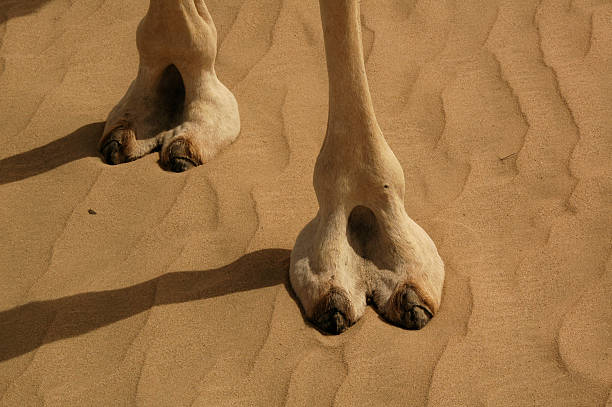
When we think of the camel, the first image that typically comes to mind is the hump—the iconic reservoir of fat that allows the animal to survive weeks without food in the harshest climates on Earth. However, there is another anatomical feature that is equally responsible for the camel’s status as the “Ship of the Desert,” yet it receives far less attention: its toes.
The camel’s foot is an evolutionary masterpiece. It is a complex system of biological engineering designed to conquer terrain that would cripple almost any other large mammal. From the unique “split” structure to the thermodynamics of its soles, the “toes of the camel” offer a fascinating glimpse into how nature adapts to extreme environments.
The Anatomy of the Camelid Foot
To understand the camel’s foot, one must first classify the animal. Camels belong to the order Artiodactyla, known as even-toed ungulates. This puts them in the same broad family as cattle, pigs, deer, and hippos. However, camels (and their South American cousins, llamas and alpacas) belong to a suborder called Tylopoda, which translates from Greek to “padded foot.”
Unlike horses (which walk on a single toe encased in a hoof) or cows (which walk on two toes encased in cloven hooves), the camel does not have a true hoof. Instead, the camel walks on two distinct toes—the third and fourth digits.
1. The Nails:
At the front of each toe is a hard, toenail-like structure. These are not weight-bearing in the same way a horse’s hoof is. They act more as a protective shield for the front of the digit and a tool for digging or traction.
2. The Didactyl Split:
The foot is split deep down the center, dividing the two toes. This split is crucial for the foot’s mechanics. It allows independent movement of the digits, which helps the camel navigate uneven, rocky terrain without losing balance.
3. The Broad Pad:
The defining feature of the camel’s foot is the massive, leathery pad that connects the two toes underneath. This is known as the plantar cushion. It is a thick, fibrous, and elastic mass of fat and connective tissue. When a camel places its weight (which can exceed 1,000 kg or 2,200 lbs) on the ground, this pad flattens and spreads out.
The Physics of the “Sand Shoe”
The primary function of the camel’s toe structure is to solve the problem of pressure. In the deep, shifting sands of the Sahara or the Arabian Desert, a heavy animal with small, hard hooves (like a horse) would sink immediately. This is simple physics: force divided by area equals pressure. A small hoof concentrates all the weight into a tiny area, piercing the sand.
The camel’s foot functions exactly like a snowshoe. As the animal steps down, the split toes widen, and the elastic pad expands outward. This drastically increases the surface area of the foot. By distributing the animal’s massive weight over a larger area, the camel reduces the ground pressure, allowing it to “float” on top of the sand rather than sinking into it.
When the camel lifts its foot, the elastic pad snaps back into a smaller shape, reducing drag and making it easier to pull the foot out of the sand for the next step. This energy-efficient mechanism is vital for an animal that may travel 30 to 40 miles a day with limited food and water.
Thermodynamics: Walking on Fire
The desert floor is not just unstable; it is incredibly hot. In the peak of summer, sand temperatures can reach 70°C to 80°C (158°F – 176°F)—hot enough to burn human skin instantly and melt the rubber soles of cheap shoes.
The camel’s toes are equipped with a specialized sole. The skin on the bottom of the pad is incredibly thick and keratinized (calloused). It acts as a powerful thermal insulator. The thick layer of fat inside the pad further insulates the bones and blood vessels of the foot from the scorching heat below. This allows the camel to stand and walk on burning sands for hours without suffering burns or overheating.
Conversely, this adaptation serves them well in the freezing nights of the Gobi Desert. The Bactrian camel (the two-humped variety found in Central Asia) utilizes the same padded foot to navigate snow and ice, proving the versatility of the design.
Traction and Terrain
While the foot is famous for sand, it is surprisingly adaptable. The texture of the sole is similar to a radial tire—rough and leathery. This provides grip on smooth rock and shifting gravel.
However, the camel’s foot does have an “Achilles heel.” Because the pad is designed for dry, loose, or rocky terrain, it performs poorly in mud. The smooth, flat surface of the pad acts like a ski on wet, slippery mud, offering zero traction. This is why camels are rarely found in wet, tropical climates; their greatest asset becomes a liability, leading to slips and potential injury.
Veterinary Care and “Slipper Foot”
Because the camel’s foot is soft tissue rather than a hard hoof, it requires different care than other livestock. In the wild, the constant abrasion of sand and rocks keeps the toenails filed down and the callouses thick.
In captivity, however, camels often face podiatry issues. If a camel is kept on soft pasture or in a stall without abrasive surfaces, the toenails can overgrow. More concerning is a condition sometimes called “slipper foot,” where the toe pad overgrows and curls upward due to a lack of wear.
Furthermore, the soft pad is susceptible to puncture wounds from sharp objects like glass, nails, or sharp thorns (like those of the Acacia tree). While the skin is tough, it is not impenetrable. A puncture can lead to an abscess deep within the fatty cushion, which is difficult to treat and can be crippling for the animal.
The Evolutionary Divergence
The study of the camel’s toes also tells us a story about the history of the planet. Camels actually evolved in North America around 40 to 50 million years ago. As they migrated—some crossing the Bering Land Bridge to Asia (becoming camels) and others moving south to the Andes (becoming llamas)—they adapted to the changing landscapes.
The evolution of the padded foot (tylopod) suggests a divergence from other hoofed animals very early on. While horses evolved the single hoof for speed on hard grasslands, the camel lineage invested in endurance and terrain versatility. This evolutionary bet paid off, allowing them to colonize environments that were uninhabitable for their competitors.
Conclusion on Toes of Camel
The phrase “toes of a camel” might seem like a minor anatomical detail, but it represents a complex intersection of biology, physics, and evolutionary history. This unique foot structure—with its didactyl split, shock-absorbing fat pad, and thermal insulation—is the unsung hero of the desert ecosystem.
Without this specialized toe design, the camel could not carry heavy loads across the Silk Road, Bedouin tribes could not have navigated the deep dunes of Arabia, and the species would likely have perished millions of years ago. The camel’s foot stands as a testament to nature’s ability to engineer perfect solutions for the most extreme problems, proving that sometimes, the most sophisticated technology is not made of silicon and steel, but of bone, fat, and skin.