
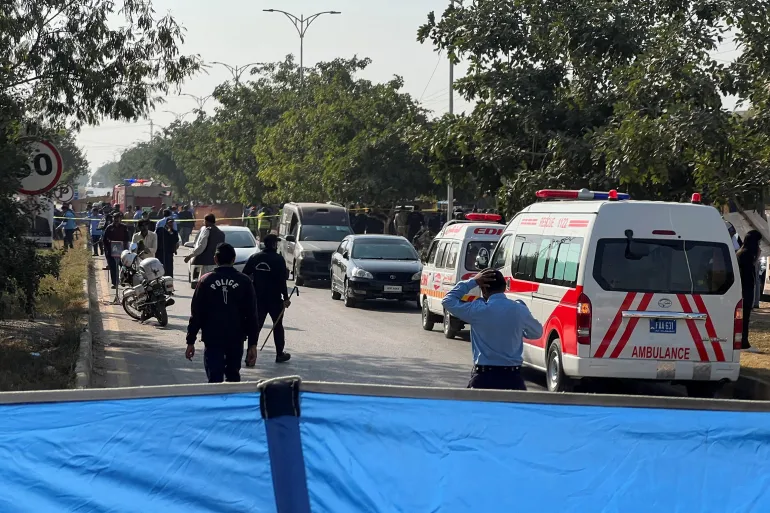
Islamabad, November 11, 2025 — Pakistan’s capital was rocked on Tuesday afternoon when a suicide bomber detonated explosives outside the District and Sessions Court Complex in Islamabad’s G-11 sector, killing 12 people and injuring at least 27 others, according to officials. The attack described as one of the most severe acts of terror in Islamabad in recent years, has reignited fears of militant resurgence in the country’s heartland.
The Attack: A Sudden Eruption of Violence
The explosion occurred shortly after 12:30 p.m., when the court was crowded with lawyers, litigants, and police personnel. Witnesses say the bomber tried to enter the courthouse but was intercepted by security forces. When stopped for checking, he triggered his suicide bomber vest near a police van, resulting in an enormous blast that shattered nearby windows and damaged vehicles parked along the street.
“I heard a deafening boom,” said Ahmad Nawaz, a lawyer who narrowly escaped the explosion. “For a few seconds, everything went silent. Then people started screaming — there was blood, smoke, and shattered glass everywhere.”
Ambulances and emergency response teams rushed to the scene within minutes. Victims were immediately transported to Pakistan Institute of Medical Sciences (PIMS), where hospital authorities confirmed multiple critical injuries.
Official Response and Condemnations
Interior Minister Rana Sanaullah condemned the attack, calling it a “cowardly attempt to undermine Pakistan’s judiciary and peace.” He added, “If any external hand is found behind this attack, it will face consequences. The state will not forgive those who seek to destabilize our nation.”
Prime Minister Shehbaz Sharif also issued a statement, mourning the victims and promising a full-scale investigation. “Terrorists will not be allowed to sabotage Pakistan’s stability. We will bring the perpetrators to justice,” he said.
Suspected Involvement and Early Leads
No militant group has yet claimed responsibility, but intelligence officials suspect the involvement of Tehrik-e-Taliban Pakistan (TTP) or its splinter cells. These groups have previously carried out similar suicide bombings targeting police, government buildings, and judicial complexes.
The timing of the attack has raised suspicions of a link to ongoing military operations against militants in the country’s northwestern tribal regions. Sources within Pakistan’s counterterrorism department suggest that the bombing may have been a retaliatory strike meant to send a symbolic message: that militants can still penetrate even the most heavily guarded areas.
Security Concerns and Aftermath
The attack has raised serious security concerns in Islamabad, long considered a safe zone compared to conflict-prone regions like Khyber Pakhtunkhwa and Balochistan. Following the bombing, security was tightened across courts, embassies, and government offices. Police checkpoints were reinforced, and drone surveillance was deployed across the city.
Lawyers’ associations across the country announced a one-day strike, demanding better security arrangements for courts and public institutions. Citizens expressed grief and outrage on social media, calling for stronger intelligence coordination to prevent future attacks.
Regional and International Reaction
Neighboring countries and global organizations, including the United Nations, United States, and European Union, condemned the attack and expressed solidarity with Pakistan. The U.S. Embassy in Islamabad issued a statement saying, “We stand with Pakistan in its fight against terrorism. Such senseless violence targeting civilians and judicial institutions cannot be justified.”
Afghanistan’s interim government also released a statement condemning the blast, though analysts in Pakistan have expressed concerns over cross-border militant movement from Afghan territory.
Analysis: What the Islamabad Blast Means for Pakistan’s Security
1. A Warning Sign of Militant Resurgence
The Islamabad bombing comes amid a noticeable uptick in terrorist activity in Pakistan. Analysts believe it highlights the growing confidence of militant networks seeking to reclaim influence after a period of relative dormancy.
The Tehrik-e-Taliban Pakistan (TTP), once considered weakened, has reportedly regrouped in parts of Afghanistan, from where it launches operations into Pakistan. The attack on a court — a symbol of law and state authority — could be aimed at undermining public confidence in the justice system and the government’s ability to protect its citizens.
2. Possible Regional Linkages
The incident also carries potential geopolitical undertones. Pakistan’s security officials have hinted at “external involvement,” though without naming a specific country. This narrative aligns with Pakistan’s ongoing concerns about militant safe havens and regional rivalries.
If investigations confirm links to groups operating beyond Pakistan’s borders, diplomatic tensions with neighboring states — particularly Afghanistan — could escalate.
3. Implications for Domestic Politics
The Bomber poses a significant challenge for the Shehbaz Sharif-led government, which is already grappling with economic instability and political tensions. Public pressure for stronger counterterrorism measures and intelligence reforms is likely to intensify. Opposition parties have already begun criticizing the government for “failing to ensure basic security in the capital.”
4. Impact on Public Confidence and Judiciary
The location of the attack — a district court — sends a chilling message. Courts are symbols of justice and state authority; an assault on such a site undermines faith in law enforcement and judicial independence. It also highlights gaps in urban security management that must be urgently addressed.
Frequently Asked Questions (FAQ)
Q1. Who carried out the Islamabad court bombing?
No group has officially claimed responsibility yet. However, initial investigations point toward the Tehrik-e-Taliban Pakistan (TTP) or affiliated extremist cells.
Q2. How many people were affected?
At least 12 people were killed and 27 others wounded, including several police officers and court employees.
Q3. Was this the first attack in Islamabad this year?
No. Islamabad has experienced sporadic security incidents in recent months, but this is the deadliest attack in nearly a decade within the capital’s limits.
Q4. What steps is the government taking now?
Authorities have launched a city-wide search operation, increased police deployment, and initiated forensic analysis of the bomb site. The government also announced compensation for victims’ families and ordered a national review of security protocols.
Q5. Why are militants targeting courts and law enforcement agencies?
Terrorist groups often view judicial and security institutions as symbols of the state’s authority. By attacking them, they seek to create fear, undermine trust in the government, and attract attention to their ideological causes.
Conclusion on Suicide Bomber
The Islamabad court suicide bomber is a tragic reminder that Pakistan’s battle against terrorism is far from over. While the country has made significant progress in dismantling militant networks, the persistence of extremist violence underscores the need for a renewed, intelligence-driven counterterrorism approach.
As investigations unfold, the blast will likely serve as a pivotal test of Pakistan’s resilience — both politically and socially — in defending its institutions and its people from those who seek to destroy peace.