
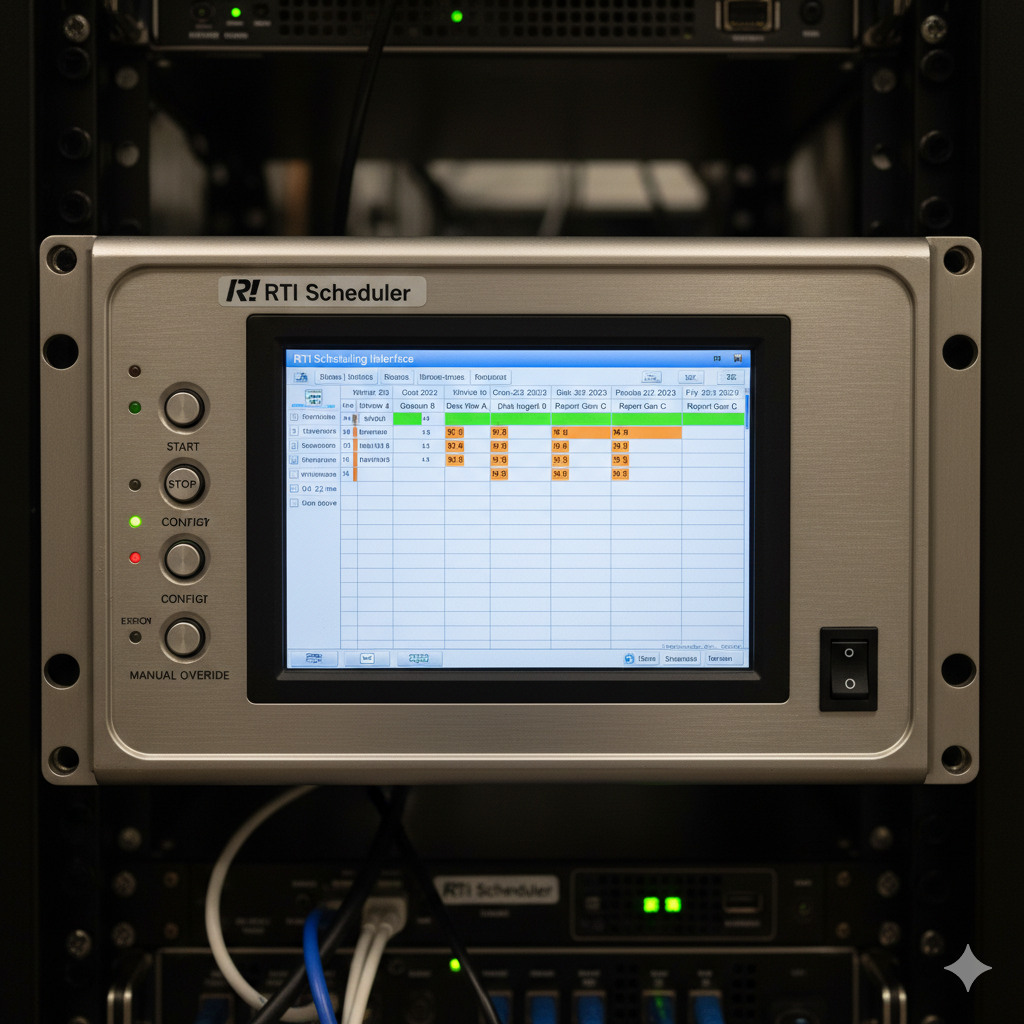
In modern embedded systems, real-time performance is one of the most crucial requirements. Systems ranging from automotive control units to industrial robots and medical devices rely heavily on timely task execution. To meet these strict requirements, RTI (Real-Time Interrupt) Scheduler plays a vital role in ensuring tasks are executed at precise intervals with deterministic behavior. This article explores what an RTI scheduler is, how it works, its applications, and why it is important in real-time systems.
What is an RTI Scheduler?
An RTI Scheduler is a mechanism within embedded systems that uses a real-time interrupt (RTI) to manage and schedule tasks at predefined intervals.
-
RTI (Real-Time Interrupt): A hardware-based timer interrupt that triggers the execution of specific routines at regular intervals.
-
Scheduler: The software component that decides which task to run when the interrupt occurs.
By combining these two, the RTI scheduler ensures that periodic tasks (like sensor sampling, motor control, or communication checks) are executed consistently and predictably.
Core Components of an RTI Scheduler
-
Hardware Timer (RTI Module):
The foundation of the scheduler is a timer peripheral, often integrated into microcontrollers. It generates interrupts after a specified time interval (e.g., every 1 ms, 10 ms, or 100 µs). -
Interrupt Service Routine (ISR):
When the RTI fires, it invokes an ISR. This ISR typically handles task activation, time counters, or signals the operating system to perform scheduling. -
Task List / Task Queue:
A data structure where tasks are defined, each with its own priority, period, and execution deadline. -
Scheduler Algorithm:
The logic that selects which task to execute next. Common algorithms include:-
Round Robin
-
Rate Monotonic Scheduling (RMS)
-
Earliest Deadline First (EDF)
-
How RTI Scheduling Works
-
Initialization:
-
Configure the RTI timer with the desired tick interval.
-
Register the ISR to handle timer interrupts.
-
-
Task Definition:
-
Each task is assigned parameters like period, priority, and execution time.
-
-
Interrupt Trigger:
-
When the timer overflows or reaches the set value, an RTI interrupt occurs.
-
-
Task Scheduling:
-
The ISR updates system ticks, checks which tasks are due, and activates them.
-
The scheduler determines the next task to execute based on the scheduling policy.
-
-
Task Execution:
-
The CPU executes the selected task.
-
On completion, the scheduler returns control until the next RTI event.
-
Advantages of RTI Scheduler
-
Deterministic Behavior: Ensures predictable timing for critical tasks.
-
Efficient Resource Use: Prevents CPU wastage by running only the necessary tasks.
-
Periodic Task Management: Ideal for systems requiring tasks at regular intervals (like sensor polling).
-
Flexibility: Works with both lightweight schedulers and full-fledged RTOS.
-
Low Latency: Immediate response to time-critical events through interrupts.
Applications of RTI Scheduling
-
Automotive Systems:
-
Engine control units (ECUs)
-
Anti-lock braking systems (ABS)
-
Advanced driver-assistance systems (ADAS)
-
-
Industrial Automation:
-
Robotics control loops
-
Process monitoring and control
-
-
Medical Devices:
-
Pacemakers and infusion pumps
-
Real-time patient monitoring
-
-
IoT and Consumer Electronics:
-
Smart home controllers
-
Wearable devices with strict timing constraints
-
Challenges in RTI Scheduling
-
Overhead from Frequent Interrupts: If the tick rate is too high, the CPU may spend too much time handling interrupts instead of executing tasks.
-
Priority Inversion: Lower-priority tasks holding resources may block higher-priority tasks.
-
Jitter: Variability in task execution timing due to interrupt delays or context switching.
-
Scalability: As systems grow complex, RTI scheduling alone may not suffice, and a full RTOS becomes necessary.
RTI Scheduler vs. RTOS Tick Scheduler
| Feature | RTI Scheduler | RTOS Tick Scheduler |
|---|---|---|
| Basis | Hardware timer interrupt | System tick from RTI or SysTick |
| Complexity | Lightweight, minimal overhead | More complex, supports multitasking |
| Task Management | Periodic tasks only | Periodic + event-driven tasks |
| Best For | Small embedded systems | Complex systems with many tasks |
Example: RTI Scheduler in Action (Pseudo-Code)
Conclusion
The RTI Scheduler is a fundamental tool in real-time embedded systems. By leveraging hardware timer interrupts, it provides precise and deterministic scheduling of periodic tasks, making it indispensable for safety-critical and performance-sensitive applications. While it may not replace a full RTOS in large systems, its lightweight nature and efficiency make it ideal for microcontrollers and time-critical tasks.
As embedded systems evolve, understanding RTI scheduling is essential for engineers aiming to design reliable, predictable, and responsive systems.
Would you like me to also make a diagram/flowchart showing how the RTI scheduler works step by step? That could make this article more visually engaging.