
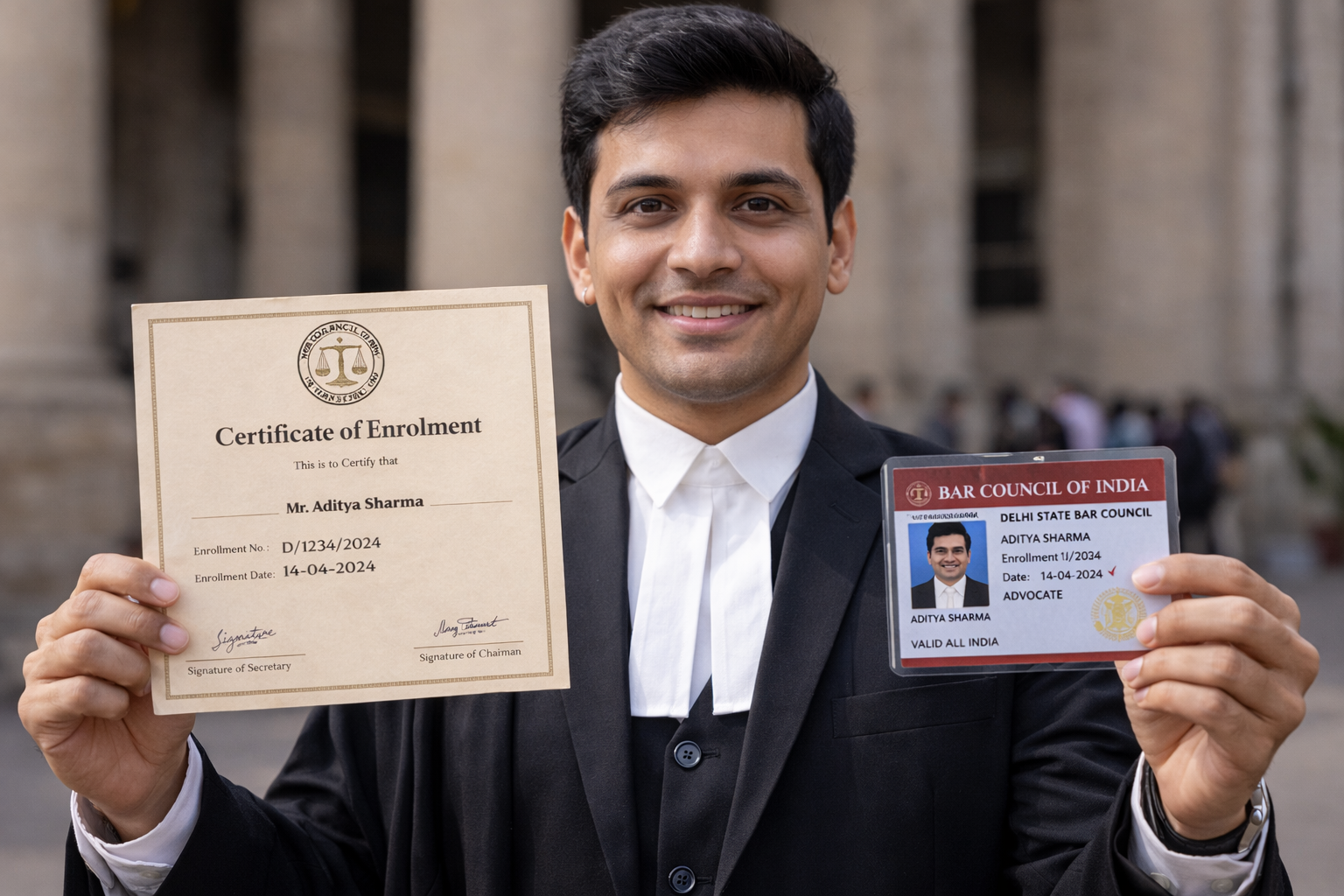
Becoming a practicing advocate in India is a structured process governed by statutory authorities established under the Advocates Act, 1961. Any law graduate who wishes to practice before courts, tribunals, or legal forums must enroll with a State Bar Council and obtain a valid Certificate of Practice. This article explains the Bar Council membership process in detail, including eligibility, documents, procedures, and important requirements.
Regulatory Authorities Governing Enrollment
The enrollment of advocates in India is regulated primarily by the Bar Council of India (BCI), which is the apex statutory body responsible for legal education and professional standards. However, the actual enrollment of advocates takes place through respective State Bar Councils such as the Bar Council of Delhi, Bar Council of Maharashtra and Goa, Bar Council of Uttar Pradesh, and others.
Each State Bar Council maintains a roll of advocates practicing within its territorial jurisdiction.
Eligibility Criteria for Bar Council Membership
To apply for enrollment as an advocate, a candidate must fulfill the following eligibility conditions:
-
Law Degree (LL.B.)
The applicant must possess a law degree (3-year LL.B. or 5-year integrated law course) from a university recognized by the Bar Council of India. -
Citizenship
The applicant must be a citizen of India. Foreign nationals may be permitted under special reciprocity rules. -
Age Requirement
There is no upper age limit for enrollment as an advocate in India. -
No Disqualification
The applicant should not have been convicted of an offense involving moral turpitude unless the disqualification period has expired.
Step-by-Step Bar Council Enrollment Process
1. Application to State Bar Council
The first step is to apply for provisional enrollment with the State Bar Council where the applicant intends to practice. The application form can usually be obtained online or from the Bar Council office.
For example, candidates intending to practice in Delhi must apply through the Bar Council of Delhi.
2. Submission of Required Documents
Applicants must submit several documents along with the enrollment form. Commonly required documents include:
-
LL.B. degree or provisional certificate
-
Mark sheets of law course
-
Proof of age (10th certificate or birth certificate)
-
Identity proof (Aadhaar, PAN, etc.)
-
Address proof
-
Passport-size photographs
-
Internship certificates (if required)
-
Character certificates from advocates or gazetted officers
-
Affidavits regarding criminal record and employment status
Some State Bar Councils may require additional documents depending on their rules.
3. Payment of Enrollment Fees
Enrollment fees include:
-
State Bar Council enrollment fee
-
Bar Council of India enrollment fee
-
Welfare fund contributions
-
Identity card charges
The fee structure varies slightly from state to state but generally ranges between ₹10,000 to ₹20,000 or more depending on welfare fund components.
4. Verification and Interview
After submission, the Bar Council verifies documents and may conduct an interaction or verification process. Once approved, the applicant’s name is entered into the State Roll of Advocates, and a provisional enrollment certificate is issued.
At this stage, the candidate becomes an advocate but must pass the All India Bar Examination to practice independently.
All India Bar Examination (AIBE)
After enrollment, advocates must appear for the All India Bar Examination conducted by the Bar Council of India. This examination tests basic legal knowledge and professional ethics.
Upon passing the AIBE, the advocate receives a Certificate of Practice, which allows them to practice law across India without restrictions.
Advocate Identity Card and Practice Rights
After enrollment and AIBE qualification, advocates receive:
-
Enrollment certificate
-
Certificate of Practice
-
Advocate identity card
These documents authorize the advocate to appear before courts including district courts, High Courts, tribunals, and eventually the Supreme Court of India (subject to additional requirements like Advocate-on-Record qualification for Supreme Court practice).
Important Rules for Advocates
Newly enrolled advocates must follow professional conduct rules prescribed by the Bar Council of India, including:
-
Maintaining professional ethics
-
Not engaging in full-time salaried employment while practicing
-
Wearing prescribed advocate dress code in court
-
Avoiding advertisement and solicitation of clients
Violation of these rules can lead to disciplinary action by the State Bar Council.
Welfare Benefits of Bar Council Membership
Membership with a State Bar Council also provides access to welfare schemes such as:
-
Advocate welfare funds
-
Insurance coverage
-
Medical assistance
-
Financial aid in case of death or disability
-
Library and professional development facilities
These benefits vary depending on the State Bar Council policies.
Common Challenges Faced by New Advocates
Many new advocates face practical challenges after enrollment, including:
-
Finding internships or senior guidance
-
Financial instability in early years
-
Court procedure learning curve
-
Building client network
However, persistence, mentorship, and continuous learning help young lawyers establish successful careers over time.
Conclusion
The Bar Council membership process is an essential gateway to entering the legal profession in India. From obtaining a recognized law degree to clearing the All India Bar Examination, each step ensures that advocates meet professional standards before representing clients in courts of law.
Enrollment not only grants the legal right to practice but also connects advocates with a professional community that supports growth, ethics, and justice delivery. For aspiring lawyers, understanding this process clearly is the first step toward a rewarding career in the legal field.