
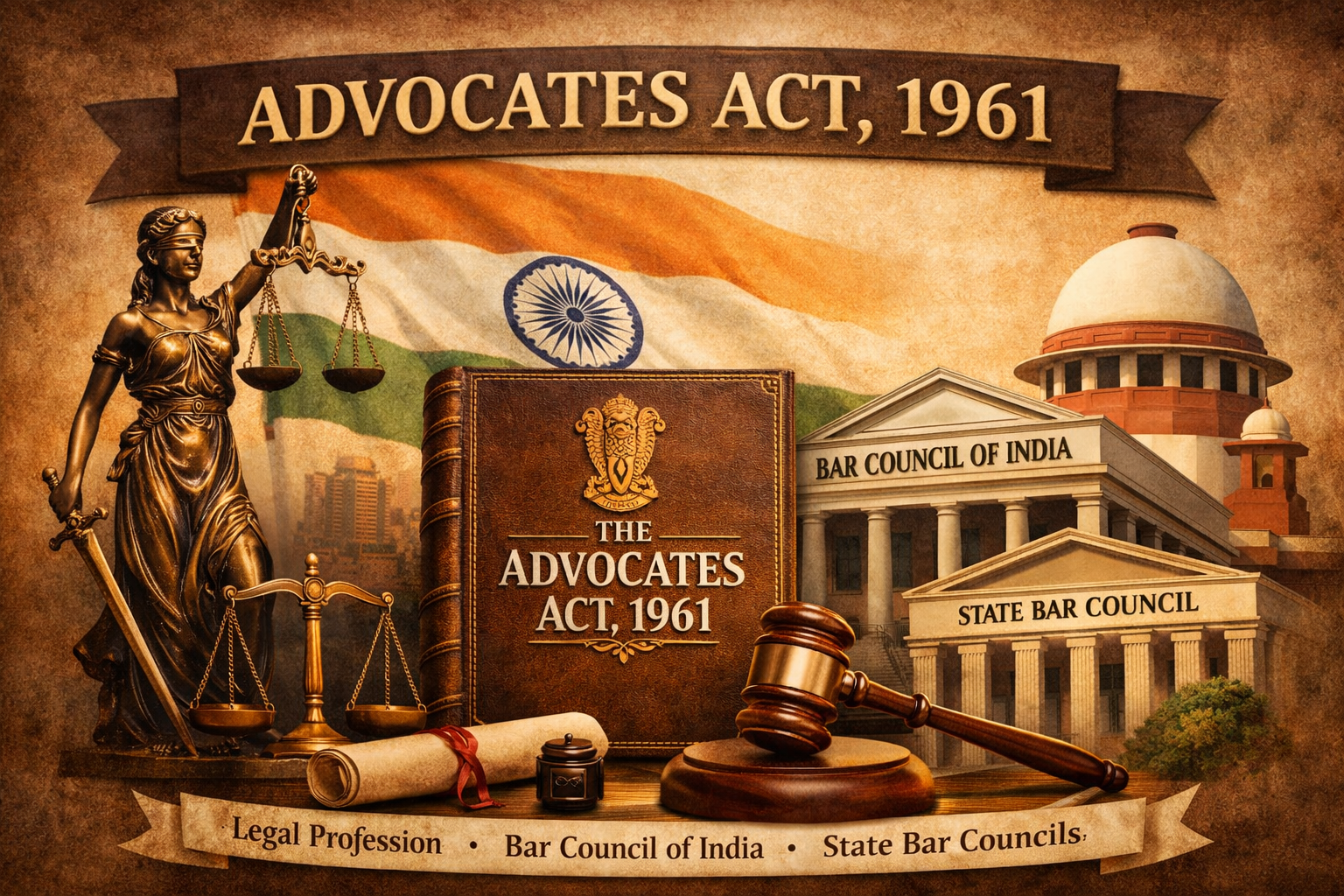
The Advocates Act, 1961 is a landmark legislation that regulates the legal profession and legal education in India. It was enacted by the Parliament of India with the objective of creating a unified legal profession and ensuring proper standards of professional conduct among advocates. The Act also established autonomous statutory bodies to manage the profession, such as the Bar Council of India and various State Bar Councils.
Before the enactment of this Act, the legal profession in India was fragmented. Different categories of legal practitioners existed, such as vakils, pleaders, attorneys, and mukhtars. Each category had different rights and privileges, which created confusion and inequality in the legal system. The Advocates Act, 1961 abolished these distinctions and introduced a single class of legal practitioners known as “Advocates.” This step helped in strengthening the legal profession and maintaining uniform standards across the country.
Historical Background
The need for a unified law regulating advocates was strongly felt after India gained independence. The All India Bar Committee was formed in 1951 to examine the condition of the legal profession in India. The committee recommended the creation of an All India Bar Council and uniform rules governing legal practitioners. Based on these recommendations, the government enacted the Advocates Act, 1961, which came into force in 1961 and transformed the structure of the legal profession in the country.
Establishment of Bar Councils
One of the most significant features of the Act is the establishment of Bar Councils at both national and state levels.
1. Bar Council of India
The Bar Council of India (BCI) is the apex regulatory body for advocates in India. It was created under Section 4 of the Act. The BCI performs several important functions related to the regulation of the legal profession and legal education.
Some of its major functions include:
-
Prescribing standards of professional conduct and etiquette for advocates
-
Regulating legal education in India
-
Recognizing law universities and colleges
-
Supervising and guiding State Bar Councils
-
Protecting the rights, privileges, and interests of advocates
-
Conducting the All India Bar Examination (AIBE)
Through these functions, the BCI ensures that the legal profession maintains discipline, competence, and integrity.
2. State Bar Councils
The Act also provides for the creation of State Bar Councils under Section 3. These councils regulate advocates within their respective states. For example, the Bar Council of Delhi is responsible for enrolling advocates and maintaining discipline among lawyers practicing in Delhi.
The major functions of State Bar Councils include:
-
Enrolling advocates on the state roll
-
Maintaining a record of practicing advocates
-
Safeguarding the rights and interests of advocates
-
Promoting legal education and law reform
-
Initiating disciplinary action against advocates for misconduct
These councils play a vital role in maintaining the professional standards of advocates at the grassroots level.
Enrollment of Advocates
Under the Advocates Act, 1961, a person who wants to practice law in India must enroll with a State Bar Council. The eligibility criteria generally include:
-
Citizenship of India
-
A law degree (LLB) from a recognized university
-
Fulfillment of other conditions prescribed by the Bar Council of India
Once enrolled, the advocate becomes entitled to practice law in courts and tribunals. However, after the introduction of the All India Bar Examination, advocates must pass this examination to obtain a Certificate of Practice.
This system ensures that only qualified and competent individuals enter the legal profession.
Rights and Privileges of Advocates
The Act grants several rights and privileges to advocates. One of the most important provisions is Section 30, which provides advocates with the right to practice throughout the territory of India. This means that an advocate enrolled in any State Bar Council can appear before courts, tribunals, and other legal authorities anywhere in the country, including the Supreme Court of India.
Advocates also have the right to represent clients, provide legal advice, and participate in the administration of justice. However, these rights come with responsibilities, and advocates must adhere to the professional standards set by the Bar Council of India.
Professional Conduct and Discipline
Maintaining professional ethics is one of the central objectives of the Advocates Act, 1961. Advocates are expected to follow strict standards of professional conduct while dealing with clients, courts, and fellow advocates.
If an advocate is found guilty of professional misconduct, disciplinary proceedings may be initiated against them. These proceedings are conducted by the disciplinary committee of the respective State Bar Council.
The disciplinary committee has the power to:
-
Reprimand the advocate
-
Suspend the advocate from practice for a specific period
-
Remove the advocate’s name from the roll of advocates
If a person is dissatisfied with the decision of a State Bar Council, an appeal can be made to the Bar Council of India, and further appeal lies with the Supreme Court of India.
This disciplinary mechanism ensures accountability and protects the dignity of the legal profession.
Regulation of Legal Education
Another important function of the Act is the regulation of legal education in India. The Bar Council of India sets standards for law courses and recognizes universities that offer legal education.
The BCI conducts inspections of law colleges and ensures that they maintain proper infrastructure, qualified faculty, and quality legal training. This system helps produce competent lawyers who are capable of serving society and the justice system effectively.
Importance of the Advocates Act
The Advocates Act, 1961 plays a crucial role in maintaining the rule of law and ensuring the proper functioning of the justice system. By regulating advocates and maintaining professional standards, the Act strengthens public confidence in the legal system.
It also protects the independence of the legal profession, which is essential for a democratic society. Advocates act as intermediaries between citizens and the courts, and their role is vital in protecting fundamental rights and ensuring justice.
Conclusion
The Advocates Act, 1961 serves as the backbone of the legal profession in India. By creating a unified class of advocates and establishing regulatory bodies like the Bar Council of India and State Bar Councils, the Act ensures discipline, professionalism, and accountability within the legal community.
Even after several decades, the Act continues to guide the functioning of the legal profession and remains essential for maintaining justice, fairness, and integrity in the Indian judicial system.