
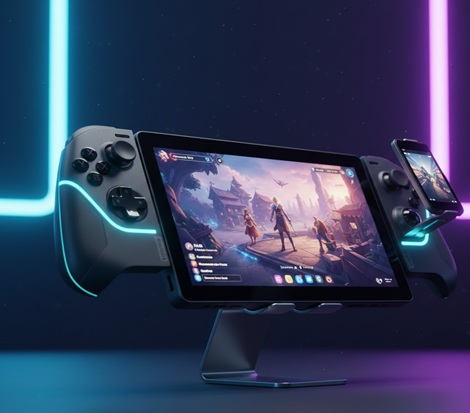
The handheld gaming PC market has shifted rapidly from a niche hobbyist corner to a mainstream battleground. When Valve launched the Steam Deck, it proved the concept; when ASUS launched the ROG Ally, it proved Windows could work on the go. But when Lenovo Legion Go 2 entered the ring with the original Legion Go, they proved there was an appetite for maximalism—huge screens, detachable controllers, and feature density.
Now, as the industry pivots toward second-generation hardware, the Lenovo Legion Go 2 stands as one of the most anticipated devices in the tech sphere. It arrives not just to iterate, but to correct the experimental flaws of its predecessor. The Legion Go 2 represents a critical maturity point for Lenovo’s gaming division, moving from “proof of concept” to “refined flagship.”
This analysis explores what we know, what we expect, and the deep market insights driving the development of the Legion Go 2.
The Architectural Shift: AMD Z2 Extreme and RDNA 3.5
The heart of the deep insight into the Legion Go 2 lies in its silicon. The first generation utilized the AMD Ryzen Z1 Extreme, a capable chip that nonetheless struggled with efficiency at lower power wattages (TDP).
The Legion Go 2 is all but confirmed to utilize the successor to this chipset, likely dubbed the AMD Z2 Extreme (based on AMD’s “Strix Point” architecture). This is not merely a speed bump; it is an architectural overhaul. The insight here is not about peak performance—handhelds are already fast enough for 720p/1080p gaming—but about performance-per-watt.
The Z1 Extreme was a sprinter; it needed high wattage (25W-30W) to shine, which decimated battery life. The Z2 Extreme, utilizing RDNA 3.5 graphics architecture, is expected to focus on low-end efficiency. If the Legion Go 2 can deliver the same frame rates at 15W that the original did at 25W, it solves the device’s biggest hurdle: mobility. Furthermore, with the rise of AI upscaling technologies like AMD’s FSR 3.1 and fluid motion frames (AFMF 2), the dedicated NPU (Neural Processing Unit) in the new chip will likely play a massive role in smoothing out frame rates without taxing the GPU, effectively giving the device “free” performance.
The Display Dilemma: VRR is Non-Negotiable
The defining feature of the original Legion Go was its massive 8.8-inch QHD+ display. It was gorgeous, but it lacked a critical feature present in its competitor, the ROG Ally: Variable Refresh Rate (VRR).
For the Legion Go 2, deep industry analysis suggests VRR is non-negotiable. In handheld gaming, frame rates fluctuate wildly. A game might dip from 60fps to 45fps during an explosion. Without VRR, this causes screen tearing and stuttering. With VRR, the screen creates a smooth visual experience even when performance drops.
Moreover, there is the issue of “Portrait vs. Landscape” native panels. The original Legion Go used a portrait screen (originally designed for tablets) rotated via software to look like landscape. This caused headaches with older games that didn’t understand the rotation. A deep insight into supply chains suggests Lenovo will likely source a landscape-native panel for the Gen 2. This subtle hardware change would eliminate 90% of the software compatibility bugs users faced on day one.
Ergonomics: Fixing the “Brick” Factor
The first Legion Go was heavy, blocky, and the detachable “TrueStrike” controllers, while innovative, dug into users’ palms. The “FPS Mode”—which turned the right controller into a vertical mouse—was a clever gimmick, but few users utilized it regularly.
For the Legion Go 2, Lenovo faces a fork in the road regarding design philosophy.
-
The Switch Model: Keep the detachable controllers but refine the shape to be more ergonomic and rounded.
-
The Unibody Pivot: Abandon the detachability to save weight and internal space (allowing for a bigger battery).
Current leaks and “Lite” model rumors suggest Lenovo might try to have it both ways. The flagship Legion Go 2 will likely retain the detachable controllers (it is their Unique Selling Proposition) but with a redesigned rail system and significantly lighter materials. However, the insight here is the button layout. The original had scattered back buttons that were easy to accidentally press. A refined design must place intentionality over quantity, moving buttons to where fingers naturally rest.
The Battery Wars: The 80Wh Standard
When the ASUS ROG Ally X was released in mid-2024, it changed the goalposts by including a massive 80Wh battery, doubling the capacity of the original. This rendered the Legion Go’s 49.2Wh battery instantly obsolete.
Lenovo cannot ignore this. A large screen consumes more power. For the Legion Go 2 to be viable, it requires a minimum of a 75Wh to 80Wh battery. Deep insight into chassis design suggests that if Lenovo optimizes the internal layout—shrinking the motherboard and using denser battery cells—they can achieve this without making the device significantly heavier. The “tethered to the wall” reputation of the Gen 1 must be shed for Gen 2 to succeed.
Software: The Windows Handheld Problem
Hardware is only half the battle. The deepest flaw of the Legion Go 1 was “Legion Space,” the proprietary launcher overlay. It was buggy, slow, and unintuitive.
Lenovo has been aggressively hiring software engineers to overhaul Legion Space. The expectation for the Go 2 is a software experience that mimics a console. This means a seamless boot-to-library experience, robust TDP controls that don’t require restarting games, and better driver integration.
Furthermore, Microsoft is slowly waking up to the handheld market. The Legion Go 2 might be one of the first devices to ship with a more optimized “Handheld Mode” for Windows 11, featuring a UI designed for touch and controller input rather than a mouse. If Lenovo can integrate their hardware inputs deeply with Windows (like the Xbox button functionality), they can bridge the gap between the friction of a PC and the ease of a Steam Deck.
The “Lite” Strategy: Market Segmentation
A crucial part of the Legion Go 2 narrative is the rumored existence of a “Legion Go Lite.” This reflects a maturing market. Just as phones have “Pro” and “Standard” models, handhelds are diversifying.
-
Legion Go 2 (Flagship): 8.8-inch screen, detachable controllers, Z2 Extreme chip, high price tag. Targeted at enthusiasts who want a portable desktop.
-
Legion Go Lite: 7-inch screen, non-detachable controllers, Z2 (non-Extreme) chip, lower price. Targeted at the Steam Deck audience.
This segmentation allows Lenovo to capture the budget-conscious market without compromising the premium features of the flagship. It is a strategic masterstroke that allows the Go 2 to be expensive and “over-engineered” because the Lite version exists to handle the volume sales.
Conclusion: The Maturity of the Titan
The Lenovo Legion Go 2 will not have the luxury of being a “novelty” that the first generation enjoyed. The market is now crowded and critical. Users are no longer impressed simply by a handheld playing AAA games; they now demand battery life, ergonomic comfort, and software stability.
The deep insight into this device suggests it will be a story of refinement over revolution. It doesn’t need a bigger screen or a wilder gimmick. It needs a native landscape VRR screen, a battery that lasts 3 hours on heavy load, and a processor that manages heat efficiently.
If Lenovo executes the hardware upgrades provided by the AMD Z2 Extreme and fixes the physical clumsiness of the first chassis, the Legion Go 2 has the potential to dethrone the Steam Deck as the king of handhelds. It represents the moment Windows handhelds stop being “prototypes” and start being true console competitors.